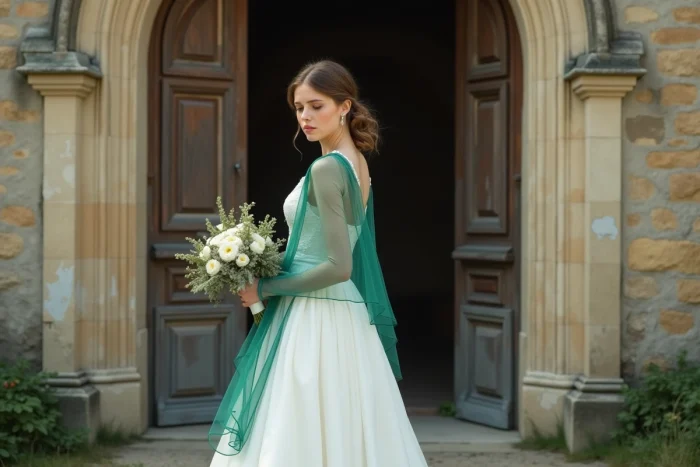
In France, some fashion houses still refused to make green wedding dresses at the beginning of the 20th century. This choice was based on a persistent belief that this color would bring bad luck during the ceremony.
This prohibition is not merely a whim or a local custom. It is the result of a set of dress codes and beliefs, rooted in centuries of European social and religious history.
Green and Marriage: Where Does the Reputation for Bad Luck Come From?
Green causes confusion. It evokes hope, fertility, but also instability and suspicion. The belief that green brings bad luck to marriage has traversed the ages, passed from mouth to mouth, and still persists in many minds, even as superstition gradually diminishes.
Historically, the color green has often been persona non grata at European weddings. In the Middle Ages and the Renaissance, obtaining a reliable green was almost miraculous: pigments derived from verdigris were both unstable and often toxic. Wearing this color was akin to betting on a fleeting hue, as if marital happiness were doomed to evaporate. Michel Pastoureau, a specialist in symbolism, notes that green was also banned from theater stages and even ships, deemed too risky, too laden with dark omens.
Gradually, Western codes reinforced this distance. After Queen Victoria’s wedding, white became the norm and supplanted all other colors. But green managed to retain its share of fascination, tinged with ambiguity. It recalls nature, fairy beings, a whole host of invisible spirits, fairies, korrigans, and goblins, who oscillate between benevolence and mischief. This cocktail of attraction and fear remains ingrained. In some regions, the green dress remains a radical, almost provocative gesture.
In the background, this belief has built up through sedimentation: fading pigments, folk tales, regional customs. The taboo carries within it the echo of ancient fears, myths, and oral transmissions.
Between Ancient Beliefs and Modern Customs: How Did Green Become a Taboo?
The wedding dress, a current symbol of innocence, has not always been white. From century to century, styles and shades have adapted to religious, social influences, and local habits. Green, although associated with luck or rebirth, found itself set aside, suspected of carrying inconsistency or the shadow of a curse.
The production of pigments provides a very down-to-earth answer to this exclusion. Once, verdigris, the very essence of green, was unstable and dangerous. Choosing this color meant risking seeing one’s dress degrade, a concrete image of marital fragility. Superstitions soon got involved: in folk tales, green-clad fairy beings, as fascinating as they were unpredictable, cast a shadow of uncertain fate over anyone who ventured into their lands.
Over time, the preference for white took over, propelled by the example of British royalty. Green, for its part, faded away, while remaining very present in the collective imagination. Yet, some brides today choose to challenge this legacy and opt for green, fully embracing their desire for uniqueness. Despite these exceptions, the transmission of the taboo continues in many families and certain regions of France, a living testament to folklore where the old always brushes against the present.

Superstitions and Traditions Today: Should We Still Fear Green at a Wedding?
Superstition still lurks around weddings, from the choice of the dress to the moment before the chosen one. Green, long suspected of bringing bad luck, remains discreet in the wedding wardrobe. But sensitivities are evolving. More and more couples see this color as a reference to nature, luck, or abundance, rather than a reminder of inconsistency.
Superstitious gestures still accompany many celebrations. Here are some examples that still color wedding days:
- Avoid making eye contact with one’s future partner before the ceremony, for fear of encountering bad luck.
- Take the time to choose the wedding date: some regions remain wary of the month of May.
- Seeing a black cat on the morning of the wedding or spotting a spider on the dress are perceived, contrary to popular belief, as encouraging omens.
The way these beliefs are transmitted depends a lot on the environments and territories. Many traditions persist, while others seem to dissipate. And green, slowly, is reclaiming its place, carried by the breath of a collective history that continues to bring it back to the forefront of French weddings.
One day, perhaps, the green dress will glide smoothly into processions, washed of all suspicion. Otherwise, it will remain on the edge of legend, a persistent nod to all that the color green continues to trouble and enchant.