
Lymphatic drainage applied to the abdomen is gaining increasing popularity. Scientific societies such as the International Lymphoedema Framework classify this technique as a comfort care and edema management method, not as a validated weight loss or body reshaping method. This gap between public perception and the medical framework deserves close examination.
What lymph does in the abdominal area
The lymphatic system transports a clear fluid, lymph, through a network of vessels and nodes. In the abdominal region, this network participates in the elimination of cellular waste, the transport of dietary fats absorbed by the intestine, and the regulation of interstitial fluid volume between tissues.
When this circuit slows down (sedentary lifestyle, stress, hormonal imbalance), fluid accumulates in the tissues. The abdomen may then appear swollen, tense, and uncomfortable. This swelling is related to water retention in the tissues, not to an increase in fat mass.
Drainage massage aims to restart this lymphatic circulation through gentle, rhythmic pressures directed towards the inguinal and abdominal nodes. The goal is to facilitate the return of excess fluid to the bloodstream for elimination by the kidneys. Anyone questioning lymphatic drainage for a deflated belly must understand this mechanism before evaluating possible results.
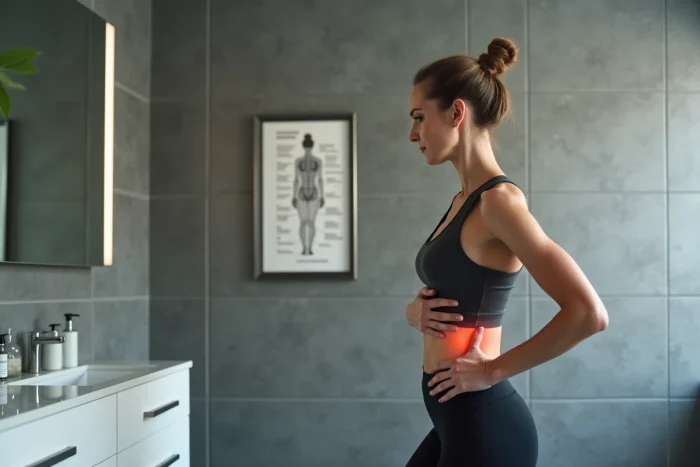
Lymphatic drainage and bloated belly: what clinical data says
A clinical review published in the Journal of Vascular Surgery: Venous and Lymphatic Disorders reminds us that manual lymphatic drainage improves peripheral edema volumes in the short term. However, no evidence of sustainable reduction in abdominal fat mass has been documented in healthy subjects.
Waist circumference may temporarily decrease. This reduction is explained by the decrease in retained fluid in the tissues, not by a loss of visceral or subcutaneous fat. The effect generally disappears within a few hours to a few days.
Functional bloating and irritable bowel syndrome
Studies on abdominal drainage in the context of irritable bowel syndrome and functional bloating show more nuanced results. Reported improvements mainly concern digestive comfort and the feeling of lightness. The available data do not allow for a conclusion about a measurable and reproducible effect on abdominal circumference.
In other words, a person suffering from bloating may feel relief after a session. The question is whether this relief is due to a physiological effect on intestinal motility or a general relaxation effect. Field reports vary on this point.
Water retention, cellulite, and silhouette: the limits to know
The most widespread confusion concerns the nature of the result obtained. Lymphatic drainage acts on three distinct phenomena:
- Local water retention, which it temporarily reduces by accelerating lymphatic return to the bloodstream
- The appearance of cellulite, which may seem diminished in the short term by the reduction of fluid trapped between adipocytes, without altering the fat structure itself
- The sensation of abdominal heaviness, often related to slowed transit or gas accumulation, on which massage can provide temporary comfort
None of these three effects constitute weight loss. Drainage does not destroy fat cells and does not alter body composition. Serious practitioners (physiotherapists, specialized masseurs) consistently clarify this to their patients.

Abdominal lymphatic drainage: conditions for a perceptible effect
The profile that benefits most from abdominal drainage is a person with marked water retention, recurrent feelings of bloating, or postoperative edema. In these cases, the technique is used in a paramedical context, often prescribed by a doctor and performed by a physiotherapist.
For a healthy person seeking a flatter belly, results depend on several factors:
- The degree of water retention at the time of the session (the greater the retention, the more pronounced the visual effect)
- The state of intestinal transit and the presence of bloating
- The regularity of sessions, as the effects of a single session are very brief
- The association with regular physical activity and a suitable diet, which remain the main levers for weight management
A comfort care does not replace a healthy lifestyle. Drainage can be integrated into a wellness routine, provided that one does not expect a lasting body reshaping.
Contraindications to check
Lymphatic drainage is contraindicated in cases of active infection, venous thrombosis, heart failure, or cancer under treatment (unless under a controlled protocol). Any session on the abdominal area should be preceded by a discussion about the patient’s medical history.
Myth or reality: what can be affirmed
Lymphatic drainage temporarily deflates the belly in individuals with water retention or bloating. This is an observable fact, confirmed by the literature on edema management. The effect is real but transient, and unrelated to fat loss.
The myth begins where this technique is presented as a solution for losing belly fat, losing centimeters sustainably, or reshaping the silhouette. No clinical data supports these claims in healthy subjects.
Abdominal lymphatic drainage has its place as a comfort care, a complement to edema management, or a tool for occasional digestive wellness. Its effects remain temporary and confined to fluid management, without impacting body composition.