
An online site for three years, pages that stagnate on the second page of Google, a click-through rate that doesn’t take off: this situation is common for SMEs that have built their web presence without technical support. Hiring a web consultant allows for a precise diagnosis of what hinders visibility and to act on the levers that really matter for SEO and conversion.
Technical audit of the site: the first lever that companies neglect
We often start by wanting to publish more content or launch advertising campaigns. The problem is that a poorly structured site absorbs these efforts without results. A web consultant first addresses the technical part, the one that no one sees but that search engines prioritize in their evaluation.
A technical audit covers the indexability of pages, loading speed, internal linking, and mobile compatibility. If Google cannot properly crawl your pages, no content strategy will compensate for this flaw. Indexing errors (orphan pages, looped redirects, misconfigured canonical tags) are common on sites created with CMSs without advanced settings.
A web consultant identifies these blockages and prioritizes corrections based on their real impact on positioning. The difference with an automated tool is the ability to cross-reference technical data with the company’s business strategy.
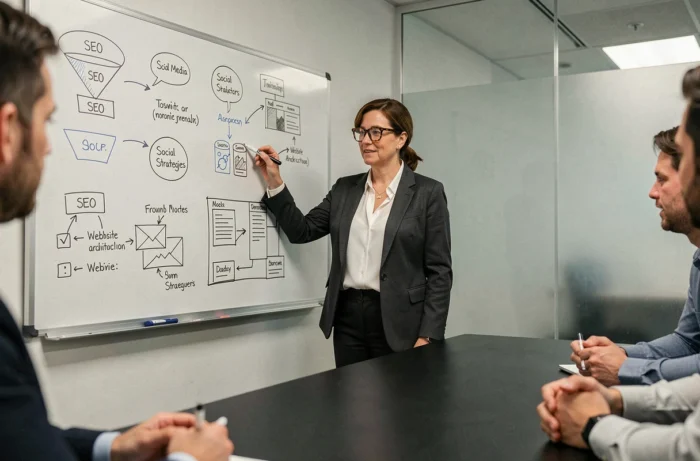
Visibility in rich results and Google’s generative responses
The Google results pages no longer resemble a simple list of blue links. Rich snippets, “People Also Ask” boxes, and AI Overviews now occupy a significant portion of the visible space. For a business, appearing in these formats radically changes the click-through rate.
According to the Google Search Central documentation updated on December 10, 2025, no specific markup or llms.txt file is required to appear in AI Overviews or AI Mode. A page must first be indexed and eligible for a standard snippet. The role of the web consultant therefore focuses on editorial quality, indexability, and trust signals, not on a distinct method sold under the name of GEO or AEO.
The query fan-out technique and its implications
Google describes an approach called “query fan-out” for its generative responses: the system launches several associated searches on different sub-topics before constructing its answer. This favors sites that can accurately answer related questions, even without precisely targeting the main query.
In practice, a web consultant structures content around a journey of related questions rather than a single keyword. This approach benefits both traditional SEO and visibility in AI interfaces.
Keyword strategy and content: where to focus efforts
Publishing regularly is not enough if the topics covered do not match the actual queries of potential customers. A web consultant starts by analyzing the search intents behind each keyword, not just their volume.
The distinction between an informational query (“how to choose a CRM software”) and a transactional query (“CRM quote for business”) determines the type of page to create and the appropriate content format. Mixing these intents on the same page dilutes the signal sent to search engines.
Here are the concrete actions that a consultant prioritizes in a content strategy:
- Mapping queries by intent (informational, navigational, transactional) and assigning each group to a distinct page type
- Identifying long-tail queries where competition is low but purchase intent is strong, to generate qualified traffic quickly
- Optimizing existing pages before creating new ones, consolidating content that cannibalizes on the same keywords
- Planning an editorial calendar aligned with seasonal search peaks in the industry

Web accessibility and regulatory compliance: an often-overlooked angle
The European Accessibility Act (EAA) has imposed digital accessibility requirements on companies selling products or services online in the European Union since June 2025. A non-compliant site is subject to penalties and loses part of its audience.
The criteria concern keyboard navigation, color contrasts, alternative text on images, heading structure, and compatibility with screen readers. This accessibility work directly aligns with SEO best practices: a well-structured page for a screen reader is also better understood by indexing bots.
A web consultant integrates these constraints from the initial audit. Correcting accessibility afterward is more expensive and takes more time than integrating it into the ongoing redesign or optimization.
Accessibility and local SEO
For businesses targeting a local clientele, the Google Business Profile remains a major lever for local visibility. The consultant checks the consistency of information (name, address, phone) between the site and directories, optimizes categories, and ensures that customer reviews receive responses.
Feedback varies on the direct impact of reviews on local rankings, but their influence on click-through rates and the trust of prospects is indisputable.
Measuring results beyond Google rankings
Focusing solely on position in search results provides an incomplete view. A web consultant implements tracking that covers several complementary indicators:
- Qualified organic traffic (visitors who match the customer profile, not just volume)
- Conversion rate by entry page, to identify which pages actually generate contact requests or sales
- Share of visibility in rich snippets and generative responses, which does not always translate into a click but enhances brand awareness
A good dashboard links each SEO action to a measurable business objective. Without this link, optimization is done blindly. The consultant translates data from Google Search Console and analytics tools into concrete decisions, month after month.
The support of a web consultant is not limited to a one-time service. Online visibility evolves with algorithm updates, new regulations, and search behaviors. Having regular technical and strategic oversight is what distinguishes sites that progress from those that stagnate after an initial optimization effort.