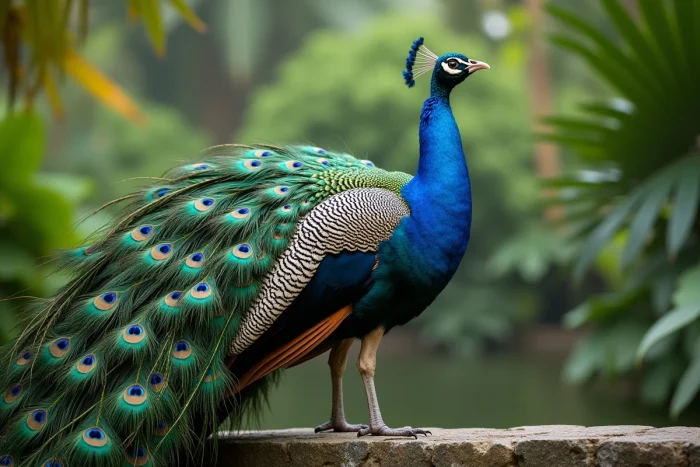
When living near a park or a property that hosts peacocks, the first contact with the animal rarely comes through its plumage. It is the cry, powerful and repetitive, that stands out. This recognizable sound is not just background noise: it follows precise logics of reproduction, territory, and alert. Understanding why the peacock makes its cry is also about decoding a behavior that breeders and residents experience or manage daily.
Acoustic and Cultural Dimension of the Peacock’s Cry
Most articles about the peacock focus on the visual display, the tail, and the plumage. The cry, however, is treated as a secondary sound detail. This is a misperception: the peacock’s vocalization is as structuring a signal as its plume of feathers.
What strikes when listening closely is that the peacock’s cry resembles an articulated word. In several languages, the very name of the bird derives from its cry. The Latin pavo is a probable onomatopoeia imitating the male’s call.
In Hindi, there are names related to the sound produced by the animal. This closeness between the cry and the name shows that, long before modern ornithology, human societies identified the peacock primarily by its voice.
In France and Europe, the peacock has long been an ornamental bird in castles and public gardens. Its cry has become a sonic marker of the place, to the point that some visitors associate it with a nearly human call. To learn everything about the peacock’s cry, one must go beyond the simple biological explanation and take into account this cultural imprint that shapes our perception of the sound.
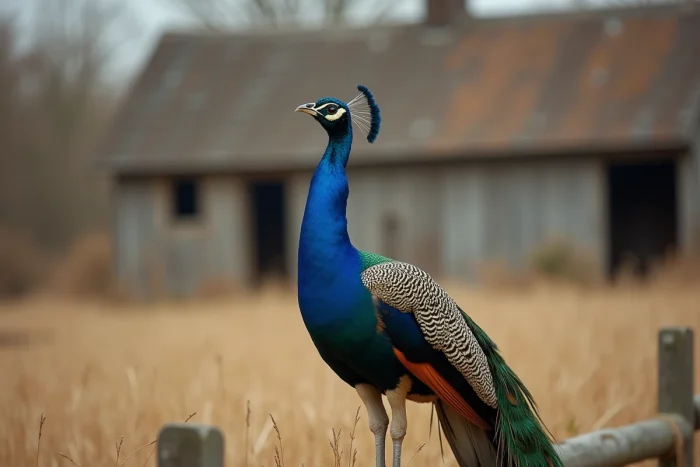
Peacock Cry During Reproduction: When and Why
The male peacock makes its most intense cries during the breeding season, in spring and early summer. This is the window when the noise is most pronounced, with a sound peak at dawn and dusk.
These calls serve two simultaneous functions. First, to attract females. The male signals his presence, vigor, and position in space. Second, to keep competitors at bay. When a female is nearby or in his area, the male intensifies his vocalizations to maintain a perimeter around him.
What the Cry Indicates About the Male’s Condition
It is observed that the most vocally active males are also the ones that display the most. The cry accompanies the display; it does not replace it. The two signals work together: the plume of feathers with its ocelli (the famous “eyes” of the plumage) captures the female’s gaze, while the cry captures her attention from a distance, sometimes over several hundred meters.
Outside the breeding season, the cry becomes significantly more discreet. If a peacock is heard crying frequently in autumn or winter, it is often a sign of external stimulation, not a display.
Alert Cry and Territorial Behavior of the Peacock
The peacock’s cry is not limited to reproduction. Outside the display season, the bird can vocally react to any disturbance in its environment. An unusual passerby, a potential predator, a sudden change in human activity around it: the peacock cries to signal a disturbance.
This behavior makes it a very vocal animal in contexts where it feels observed or disturbed. Breeders know this well: a peacock stressed by its environment cries more than a peacock settled in a calm space. Feedback varies on this point depending on the terrain configuration, but the general trend is clear.
- A peacock placed near a busy road or a frequented path will cry more often, even outside the breeding season.
- A change in the group (arrival of a new animal, disappearance of a peer) can trigger prolonged vocalizations.
- The presence of dogs, cats, or birds of prey nearby causes brief and repeated alert cries, different from the display cry.
Differentiating the Display Cry from the Alert Cry
The display cry is long, modulated, often in two rising syllables. The alert cry is shorter, sharper, with a rapid repetition frequency. In the field, one quickly learns to tell the difference: the alert cry stops when the threat disappears, while the display cry can last for hours during the season.
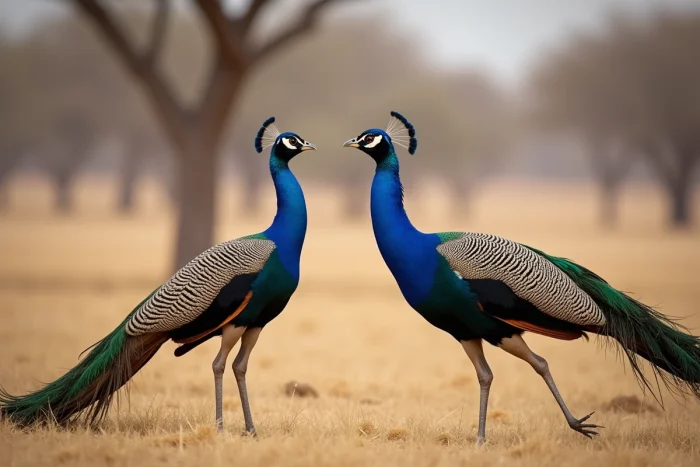
Male and Female Peacock: Who Cries and in What Context
The male is by far the loudest. He carries the plume of feathers, displays, and accompanies his display with powerful vocalizations. The female (peahen) is more discreet, but she is not silent either.
The peahen emits shorter and lower sounds, often to communicate with her chicks or to respond to the male in a vocal exchange. These exchanges are rarely mentioned, even though they are part of the overall communication system of the species.
- The male cries to attract, mark his territory, and alert.
- The female vocalizes mainly in a maternal context or in direct response to the male.
- Young peacocks begin to make sounds similar to those of adults long before they have their definitive plumage.
In a breeding or park setting, understanding who cries and when allows for anticipating noise disturbances and better managing coexistence with the neighborhood. A solitary male without a female nearby often cries more, as the call goes unanswered and prolongs.
The peacock’s cry is therefore not a mere sound whim. It is a complete communication tool, rooted in the bird’s biology and amplified by the living conditions provided. Adapting the space, limiting sources of stress, and respecting seasonal rhythms remain the best levers for cohabiting with this bird without suffering its decibels.