An increasing number of students are entering a specialized preparatory program without having made a definitive career choice or established a solid project. Admission committees regularly validate applications that reflect vague or fragmented intentions, betting more on creative potential than on clarity of objectives.
The assessment at the end of the training reveals that refining the personal project often constitutes the main gain. In many cases, the preparatory program serves as a space for clarification, rather than a springboard towards a pre-defined career.
Why do so many students arrive in prep with a vague artistic project?
Entering a preparatory year for creative professions often means moving forward in the dark. Many high school students find themselves writing their motivation letter on Parcoursup while juggling hesitant ideas, multiple desires, but rarely a precise direction. Between parental expectations, academic pressure, and the difficulty of grasping the reality of various artistic professions, confusion sets in. It is not uncommon for their experience to be limited to a few art classes or extracurricular workshops, with no clear perspective on what awaits behind the doors of a creative field.
Career advisors, sometimes overwhelmed by the rapid evolution of the sector—graphic design, animation, interactive design—struggle to provide solid reference points. In high school, the space left for artistic discovery remains marginal, offering few opportunities to concretely build a portfolio or explore different paths. As a result, there is often a significant gap between the idea one has of a profession and what it actually entails.
The preparatory program then appears as a meeting point: a space for friction and experimentation, where one encounters other trajectories, confronts their ideas, and sheds some illusions. It serves as a transition to explore desires, test abilities, and sometimes surprise oneself by changing course or redefining ambitions under the gaze of seasoned professionals. For many students, the challenge is to confirm their creative project with a preparatory program in entertainment: questioning their project, testing it, shifting it, far from ready-made promises or idealized images.
The entertainment preparatory program: a laboratory to test ideas without pressure
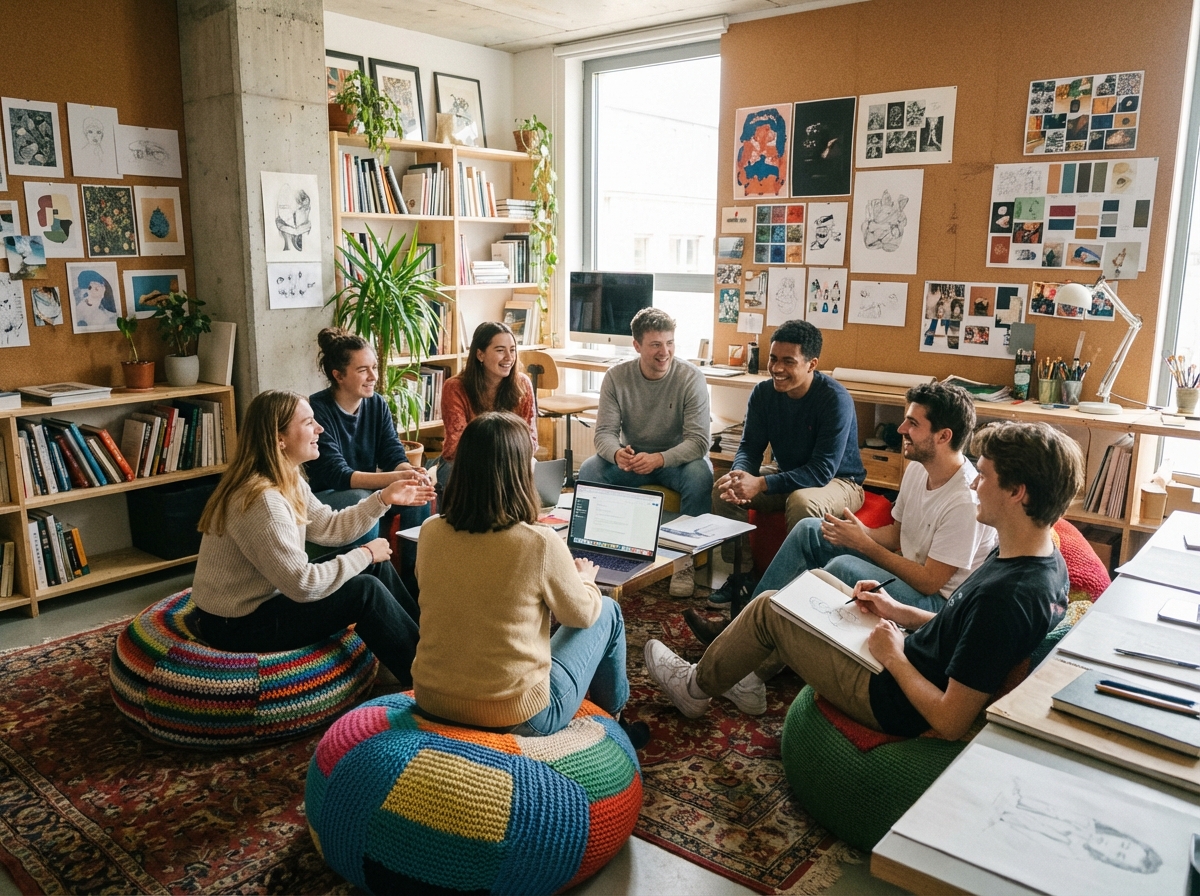
In Entertainment prep, everything revolves around experimentation, boldness, and questioning. This year acts as a laboratory: everyone experiments, makes mistakes, starts over, without the threat of an overly early specialization. The pace is intense, with workshops, workshops, and group projects, but the goal is not to produce the perfect piece. Each person confronts their choices, accepts the gaze of others, learns to stand by their decisions in front of demanding yet supportive peers and instructors.
Creativity is forged here in the diversity of techniques and collective emulation. Observation drawing exercises, graphic manipulations, and art history serve as playgrounds, or more precisely, opportunities to explore, divert, and intersect disciplines. The use of design expands to social networks, questioning the impact of images, their dissemination, and their adaptation to new formats. In this context, learning about letter spacing or mastering the subtleties of cls letter spacing is not a mandatory step, but a necessity of meaning, a constant adjustment to the technical realities of the sector.
Here are some concrete aspects that mark this journey:
- Meeting professionals from the sector
- Multiplying attempts without fearing failure
- Adapting one’s perspective to digital uses
As the weeks go by, each person shapes their own way of expressing their ideas. Animation and Entertainment preparatory programs offer this testing ground, where one refines their approach, adjusts their desires, without a definitive choice closing the parentheses too quickly.
Validating (or reinventing) one’s creative project: what really happens during the year
Shielded from external scrutiny, this year acts as a revealer: the creative project is put to the test of practice. Few arrive with a clear idea; most move forward hesitantly, doubting, readjusting according to feedback. The steps follow one another: building a portfolio, developing an artistic dossier, designing a end-of-year project, and each involves questioning oneself, defending one’s positions, and reformulating one’s approach in the face of concrete expectations.
The technical tools acquired over the months allow for structuring one’s desires. Creativity is strengthened under the watchful eye of juries, in the confrontation with real exercises. There is no miracle method, but a succession of challenges that force clarity and honesty about what one truly wishes to defend.
Here is what students are expected to accomplish during this period:
- Build a solid, documented, and evolving proof of work
- Demonstrate the ability to defend a project before a jury
- Adapt the initial idea to technical and artistic realities
In this process, validating the creative project is not limited to achieving a numerical success or obtaining a title from the RNCP. Hesitations, failures, and detours are an integral part of the process. Feedback gathered online, exchanges with others, advice from alumni: all these are resources to refine one’s vision, bounce back, and sometimes even reinvent one’s entire trajectory. Upon leaving, some find their path, while others depart with a new idea, the result of an unexpected detour or a failed attempt that opened up new horizons.
When the preparatory program closes its doors, it is not a fixed project that emerges, but a sharpened desire to continue, to explore, to build. Because, ultimately, in this creative transition, the true wealth lies in having learned to doubt, to dare, and to reinvent oneself.