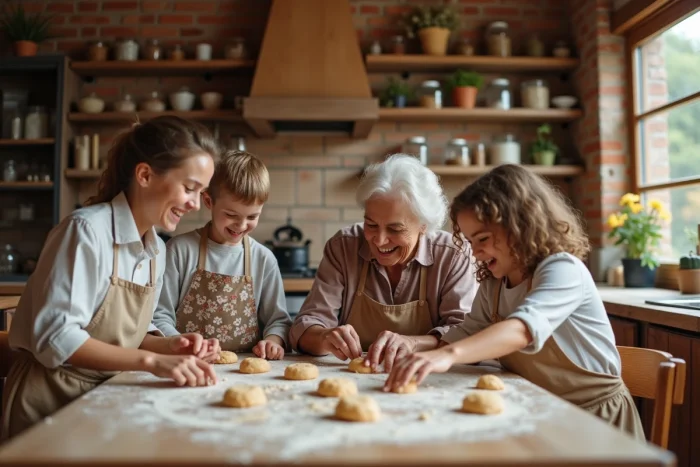
A child recounting their day at the table, a parent putting down their phone to listen to a story, a grandparent calling every Sunday at the same time: family bonds are rarely built during big occasions. They are woven through repeated, brief, almost invisible gestures. Strengthening family ties in daily life relies less on the quantity of time spent together than on the quality of these shared moments.
Emotional Regulation of Parents: The Invisible Foundation of Family Bonds
Have you ever noticed that a stressed or exhausted parent has a much harder time being available for their children? Recent research in positive psychology emphasizes a point that traditional guides overlook: the emotional regulation of the adult conditions the quality of the bond.
Specifically, a parent overwhelmed by their mental load reacts more sharply to a request for attention. The child perceives this rejection, even if unintentional, and learns to ask less. The bond weakens without visible conflict.
Before looking for family activities, it can be helpful to ask a simple question: am I in a state to be present? This can involve habits that allow you to discover family on Perceptum from a calmer perspective, taking care of yourself to better care for others.
Some concrete practices help reduce this adult overload:
- Identify a daily moment of decompression, even brief, before reuniting with the children (walking, reading, intentional silence)
- Verbalize your emotional state in front of your children without dramatizing: “I am tired, I need five minutes” also teaches the child to name their own emotions
- Delegate or eliminate one household task per week to free up mental time, not just physical time
This work on oneself is not a luxury. It is the condition for family micro-rituals to truly function.

Family Micro-Rituals: Brief Gestures That Create Continuity
Recent publications on family relationships show a clear shift: families that maintain a strong bond do not multiply exceptional outings. They rely on short, repeated, and predictable rituals.
A micro-ritual is a gesture that occurs at the same time, in the same format, often enough to become a reference point. The child knows they can count on it. The parent does not need to plan it.
Examples of Micro-Rituals to Adapt by Age
For a young child, the bedtime ritual works particularly well: a story, a song, a repeated word each night. It’s not the content that matters, it’s the regularity.
For a teenager, the format changes. A car ride without music, a shared meal without screens, a short message sent after a tough day. The teenager does not ask for attention, but they notice it when it is there.
For distant grandparents, a fixed-time call each week creates an invisible thread. The conversation can last three minutes. What maintains the intergenerational bond is consistency, not duration.
What Distinguishes an Effective Ritual from a Burdensome Routine
A family ritual only works if it is chosen, not imposed. Sunday dinner becomes a chore as soon as it turns into an obligation. Proposing rather than forcing remains the best approach.
A good ritual lasts less than fifteen minutes and requires no logistics. If you have to book, buy materials, or block a time slot, it’s no longer a micro-ritual, it’s an activity. Both are useful, but they do not serve the same function.
Family Communication: Listen Before Advising
The majority of content on family communication focuses on “talking more.” The problem is rarely a lack of words. It’s a lack of real listening.
Really listening means resisting the urge to correct, reassure, or propose a solution. When a child says “I had a bad day,” the most effective response is often “tell me about it” rather than “it will be okay.”
This posture of active listening requires conscious effort. The parent, used to solving problems, must accept not to fix anything for a few minutes. The child learns that their emotions have value, even when there is no immediate solution.
Screens as a Concrete Obstacle to Listening
Setting limits with smartphones during certain key moments (meals, trips, bedtime) is not parental control. It’s a practical condition for family communication to exist.
A phone placed on the table, even turned off, alters the quality of the exchange. Family members talk about more superficial topics and share less. Physically removing the device from the room measurably changes the dynamic.

Shared Activities Across Generations: Choose Simplicity
Board games, cooking, gardening, walking: these activities appear in all recommendations because they work. Their common point is not originality. It’s that they allow people to be side by side without performance pressure.
The best family activities are those where you can talk while doing something else. A child helping to prepare a cake opens up more easily than a child sitting across from an adult who is asking them questions.
- Card or board games create a structured setting where everyone has a role, regardless of age
- Shared reading (reading aloud, even to a teenager) maintains an often underestimated emotional bond
- Hands-on projects (DIY, gardening, repairs) value the transmission of know-how between generations
The goal is not to fill a family agenda. It’s to create contexts where the bond can form without apparent effort. The emotional development of the child happens through these informal moments, not through structured educational programs.
Families that strengthen their ties daily share a common trait: they do not seek relational perfection. They accept silences, failed meals, Sundays when no one wants to play. The family bond withstands boredom and temporary tensions, provided it is based on regular gestures and sincere availability.