
Tupac Shakur lived in at least three major American cities before his Death Row years, and each left an audible mark on his discography. Tracing his footsteps from New York to Los Angeles measures the gap between places that still exist and those that have already disappeared.
Some murals have been demolished along with the buildings that housed them, studios have changed functions. The question that structures this itinerary is not only geographical: it concerns what remains to be seen, what has been erased, and what the collective memory has relocated.
Tupac’s Accessible Locations vs. Disappeared Sites
An itinerary tracing Tupac Shakur’s path requires distinguishing verifiable stops from ghost addresses. The table below groups the main documented sites from available sources, categorized by city and state of preservation.
| City | Location | Current Status |
|---|---|---|
| New York (Harlem) | Apollo Theater, 253 West 125th Street | Open to the public, active programming |
| Baltimore | Baltimore School for the Arts | Active institution |
| Oakland | Tupac mural | Destroyed during partial demolition of the building |
| Los Angeles (Hollywood) | Star on the Walk of Fame | Unveiled shortly before his 52nd birthday |
| Las Vegas | Intersection related to the shooting | Public road, no permanent official memorial |
What stands out from this survey is the imbalance between the East Coast and the West Coast. New York and Baltimore maintain stable institutional locations (a theater, a school), while the Californian traces oscillate between recent tributes and silent disappearances.
The Oakland mural illustrates a recurring problem in hip-hop-related tourism. Documentation on the preservation of mural art indicates that the work was lost during demolition work, without prior public archiving. For a traveler, this means that a planned stop based on an Instagram photo may no longer exist upon arrival.
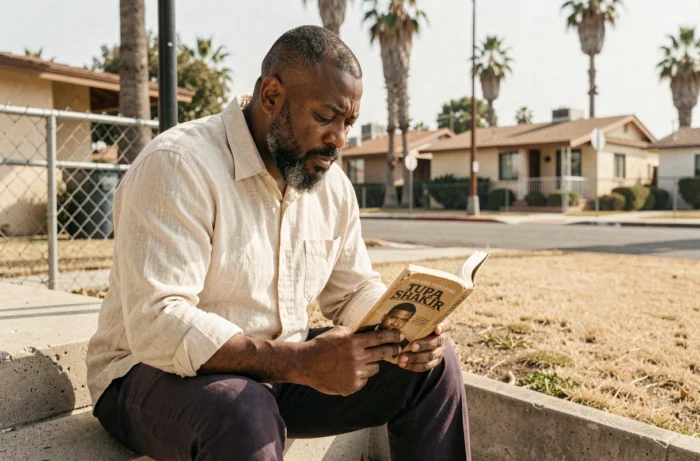
This gap between digital memory and physical reality reminds us that any cultural itinerary relies on prior verification. As specialized platforms for thematic routes in Europe do, such as Brittany Unpacked for Brittany, documenting a location before visiting helps avoid unnecessary detours.
Tupac’s Artistic Training in Baltimore and Harlem
Most narratives dedicated to Tupac Shakur begin with California or the Las Vegas shooting. His training path, however, passes through less spectacular but crucial stages for understanding his music.
The Apollo Theater Before Rap
Tupac performed at the Apollo Theater when he was still a teenager, before becoming known as a rapper. This fact, reported during the unveiling ceremony of his star on the Walk of Fame, anchors his connection to New York in stage performance rather than in the recording studio.
The Apollo, located at 253 West 125th Street in Harlem, remains a venue for live performances. A visitor can attend a show without any plaque indicating Tupac’s presence, but the building itself is part of the narrative.
Baltimore School for the Arts: Theater, Poetry, and Ballet
In Baltimore, Tupac studied at the Baltimore School for the Arts, where he worked on theater, poetry, jazz, and ballet. This multidisciplinary training partly explains the literary dimension of his lyrics and his physical presence on stage.
Narrowing Tupac’s itinerary to New York and Los Angeles erases Baltimore, which remains the place where his artistic sensitivity was shaped. The school is still operational. It does not offer a dedicated tourist visit for its former students, making it an external observation stop.
- Apollo Theater (Harlem): accessible, regular shows, no specific signage for Tupac
- Baltimore School for the Arts: functioning educational institution, exterior visit only
- East Harlem neighborhood where Tupac grew up: residential area, no official landmark
Tupac Shakur’s Star on the Hollywood Walk of Fame
The most recent traces of Tupac in Los Angeles are also the easiest to locate. His star on the Hollywood Walk of Fame was unveiled shortly before what would have been his 52nd birthday, making it a relatively recent addition to the boulevard.
The star remains the only easily accessible official stop in Los Angeles. The rest of the Californian route consists of private addresses, converted studios, or repainted walls. Death Row Records, the label that produced All Eyez on Me, does not have a visitable headquarters today in this form.
This concentration of accessible locations in Hollywood gives a partial image. Los Angeles played a significant role in Tupac’s life for its studios, collaborations, conflicts, and daily life, but the city does not preserve these traces in the form of a marked route.
Disappeared Hip-Hop Murals: An Urban Preservation Issue
The issue of murals deserves separate development because it conditions the reliability of any cultural itinerary related to rap.
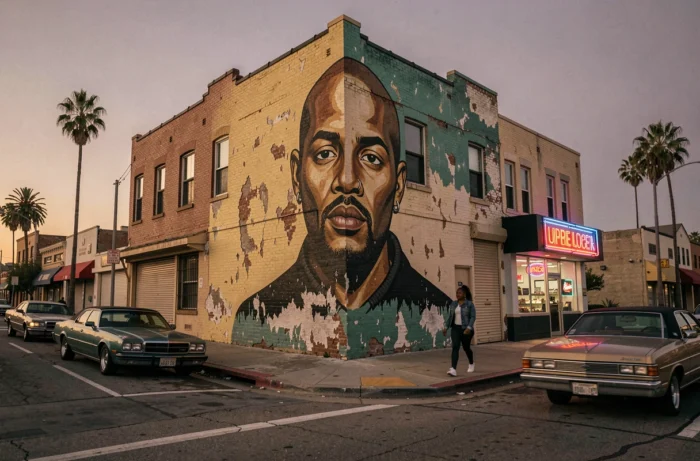
A Tupac mural in Oakland disappeared with the demolition of the building that housed it. This is not an isolated case. Urban mural art is subject to real estate pressure, façade renovations, and sometimes the simple passage of time. An exterior wall exposed to the elements does not last as long as a canvas under glass.
For a traveler planning a Tupac itinerary, the practical consequence is direct: murals spotted on social media or in blog articles may no longer exist. Geolocated photos on Instagram do not carry a verification date.
- Check the existence of a mural via recent local sources before visiting
- Keep your own geolocated photos to contribute to collective archiving
- Prefer murals protected by a documented preservation program
The disappearance of these works also transforms the meaning of travel. The absence of a place can tell as much as its presence: an empty wall in Oakland says something about the place of hip-hop in urban memory.
Las Vegas, the Last Chapter of a Tupac Shakur Itinerary
Las Vegas closes the geographical journey of Tupac. The intersection where the shooting took place remains an ordinary public road, without a permanent memorial. The conviction of Duane “Keffe D” Davis for first-degree murder closes the judicial chapter, ending decades of proceedings.
This legal outcome has not changed the physical landscape of Las Vegas. No monument, no plaque has been installed at the site of the shooting. The place exists in collective memory through documentaries and photographic archives, not through on-site signage.
This absence of an official marker in Las Vegas contrasts with the Hollywood star. It reflects a tension between the desire to honor an artist and the difficulty of inscribing a violent event in public space. For the visitor, Las Vegas remains a symbolic stop, devoid of dedicated tourist infrastructure for Tupac.
The complete itinerary, from Harlem to Las Vegas via Baltimore, Oakland, and Los Angeles, thus covers places of very different natures: a school, a theater, a star on the sidewalk, an empty wall, and an anonymous intersection. What connects these stops is not a marked route but a personal reconstruction, based on prior verification and the acceptance that some places exist only in archives.